
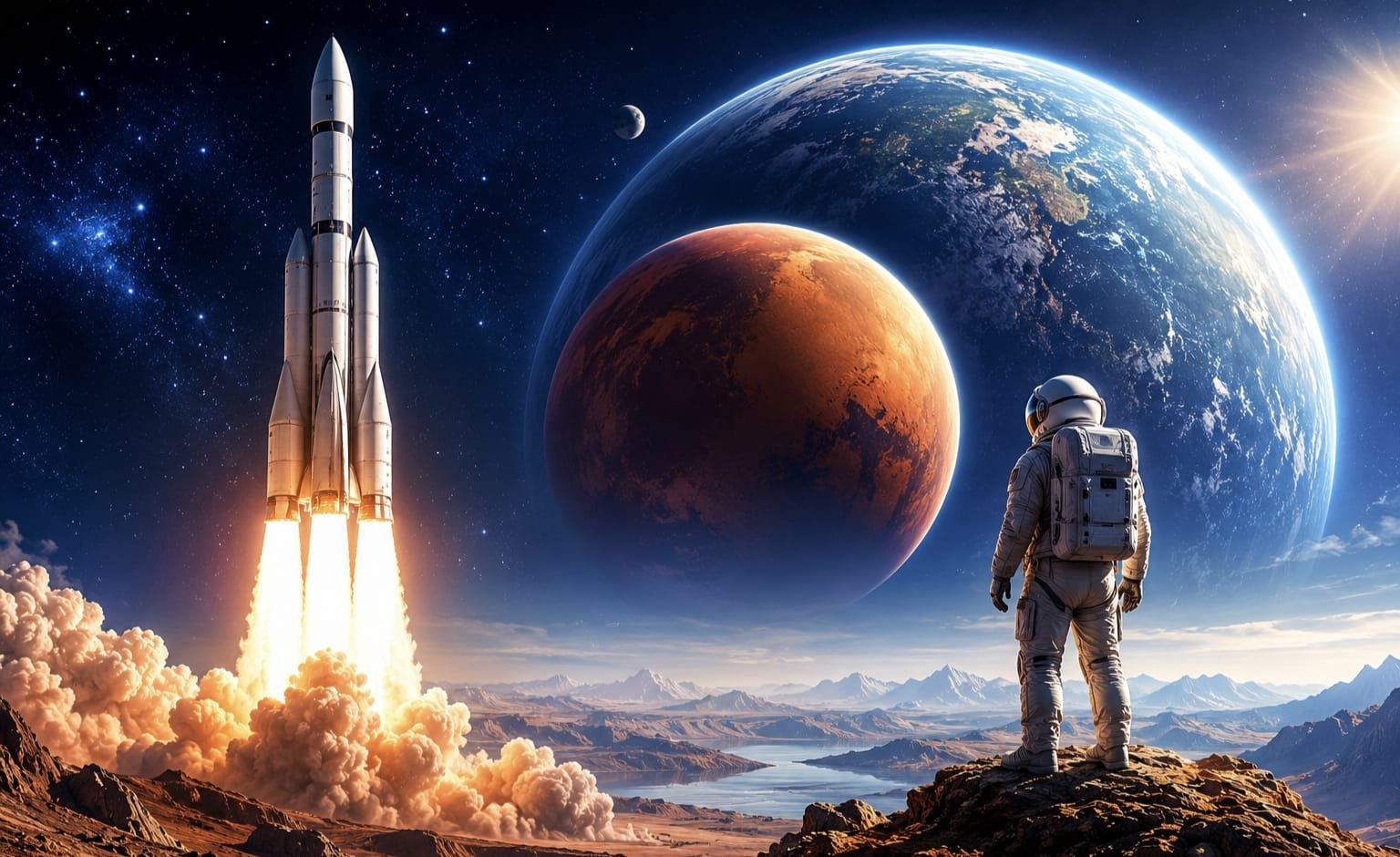
For thousands of years, humans have looked up at the night sky and wondered what lies beyond Earth. The stars, planets, and distant galaxies have inspired countless stories, discoveries, and dreams. Today, thanks to rockets, humanity has begun turning those dreams into reality. Rockets are powerful machines that carry spacecraft beyond Earth’s atmosphere, allowing us to explore the Moon, visit distant planets, and study the universe.
As technology continues to advance, many people ask an exciting question: Can rockets take us to new worlds? The answer is yes—but the journey is far more challenging and fascinating than many imagine. Rockets are already helping us explore other worlds, and they may one day allow humans to live beyond Earth
What Is a Rocket?
A rocket is a vehicle designed to travel by pushing gases out of its engines at extremely high speeds. This action creates thrust, which propels the rocket upward and forward. Unlike airplanes, rockets can operate in space because they carry both fuel and an oxidizer, allowing them to function without air.
Rockets are among the most powerful machines ever built. They must overcome Earth’s gravity, which constantly pulls objects toward the ground. To reach space, rockets generate enormous amounts of force during launch.
Modern rockets are used for many purposes, including launching satellites, delivering supplies to space stations, conducting scientific research, and carrying astronauts into space.
The First Steps Beyond Earth
Humanity’s journey to new worlds began in the twentieth century. Early rockets made it possible to send satellites into orbit and eventually transport astronauts beyond Earth’s atmosphere.
One of the greatest achievements in human history occurred in 1969 when astronauts landed on the Moon. This mission proved that rockets could carry people to another world and bring them safely back home.
Since then, rockets have sent spacecraft to nearly every planet in our solar system. Robotic explorers have visited Mars, Venus, Jupiter, Saturn, and many other celestial bodies, collecting valuable information about these distant environments.
Exploring Mars
Among all the planets in our solar system, Mars is considered one of the most promising destinations for future human exploration.
Mars shares several similarities with Earth. It has seasons, polar ice caps, mountains, and valleys. Scientists believe that billions of years ago, liquid water may have flowed across its surface.
Rockets have already carried numerous robotic missions to Mars. Rovers have traveled across the Martian landscape, analyzing rocks, searching for signs of past life, and studying the planet’s environment.
Many space agencies and private companies are now developing rockets capable of transporting humans to Mars. Although such missions remain challenging, they are becoming increasingly realistic.
Why Explore New Worlds?
Exploring new worlds is about much more than satisfying curiosity. Space exploration provides valuable scientific knowledge and technological advancements that benefit life on Earth.
By studying other planets, scientists learn more about how our own planet formed and evolved. Exploring space also helps us understand climate systems, geological processes, and the possibility of life elsewhere in the universe.
There is also a practical reason for exploring new worlds. Earth faces challenges such as population growth, resource limitations, and natural disasters. Some experts believe that establishing human settlements beyond Earth could help ensure the long-term survival of humanity.
The Challenges of Space Travel
Although rockets can take us to new worlds, the journey is not easy. Space travel presents many difficulties that scientists and engineers must overcome.
Distance
Space is incredibly vast. Even the closest planets are millions of kilometers away. Traveling to Mars can take several months using current technology.
Radiation
Earth’s atmosphere and magnetic field protect us from harmful cosmic radiation. In deep space, astronauts are exposed to higher levels of radiation, which can affect their health.
Life Support
Astronauts need air, water, food, and shelter throughout their journey. Designing systems that can provide these necessities for long periods is a major challenge.
Extreme Environments
Other planets often have harsh conditions. Mars is extremely cold, while Venus has crushing atmospheric pressure and intense heat. Any human settlement would need advanced technology to survive.
New Rocket Technologies
Modern engineers are developing new rocket technologies that could make space travel faster, safer, and more affordable.
Reusable rockets are one of the most important innovations. Traditionally, rockets were used only once and then discarded. Today, some rockets can return to Earth and be launched again, significantly reducing costs.
Scientists are also researching advanced propulsion systems that may one day allow spacecraft to travel much faster than current rockets. Nuclear propulsion and ion engines are among the technologies being explored.
These innovations could dramatically expand humanity’s ability to reach distant worlds.
Could Humans Live on Other Planets?
Many researchers believe that humans could eventually establish permanent settlements beyond Earth.
Mars is often considered the best candidate because it has resources that could support human life. Water ice exists beneath the Martian surface, and future technologies may allow astronauts to produce oxygen and fuel using local materials.
Scientists are also investigating the possibility of creating habitats on the Moon. Lunar bases could serve as stepping stones for deeper space exploration.
Living on another planet would require significant adaptation, but it is no longer considered impossible. What once existed only in science fiction is gradually becoming a scientific goal.
Beyond Our Solar System
While rockets may eventually help humans settle on Mars or the Moon, reaching planets outside our solar system is a much greater challenge.
The nearest star system, Alpha Centauri, is more than four light-years away. With current rocket technology, reaching it would take tens of thousands of years.
Scientists are exploring revolutionary concepts such as light sails, fusion propulsion, and other advanced technologies that could make interstellar travel possible in the distant future.
Although such journeys remain beyond our current capabilities, history has shown that technological progress often turns impossible dreams into reality.
Inspiring Future Generations
Rockets do more than carry spacecraft into space—they inspire people around the world. Images of launches, planetary discoveries, and distant galaxies encourage young people to pursue careers in science, technology, engineering, and mathematics.
Many of today’s engineers and astronauts were inspired by space missions they witnessed as children. As new generations continue to dream about exploring the universe, rockets will remain symbols of human ambition and innovation.
The desire to explore has always driven humanity forward, and rockets are among our greatest tools for satisfying that curiosity.
Conclusion
Can rockets take us to new worlds? The evidence suggests they can. Rockets have already carried humans to the Moon, sent robotic explorers across the solar system, and opened a new era of space exploration. While challenges remain, advances in technology continue to bring distant destinations within reach.
The dream of visiting Mars, establishing lunar bases, and perhaps one day traveling beyond our solar system is no longer pure fantasy. With determination, innovation, and continued exploration, rockets may help humanity expand its presence far beyond Earth.
As we look toward the stars, rockets remain our bridge to the unknown, carrying us toward discoveries, adventures, and worlds that await beyond the horizon.