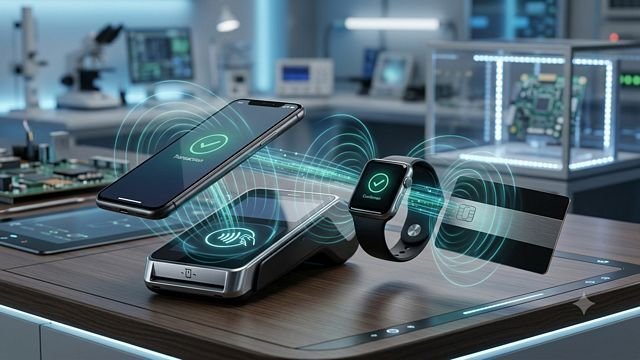
In today’s digital world, people can make payments, share information, unlock doors, and connect devices with a simple tap of their smartphones. One of the technologies that makes these convenient actions possible is NFC, which stands for Near Field Communication.
Although many people use NFC every day without realizing it, the technology has become an important part of modern life. From contactless payments and digital wallets to smart cards and wireless pairing, NFC enables secure communication between devices over very short distances.
Understanding how NFC works helps explain why a simple tap can perform tasks that once required physical cards, cash, cables, or passwords.
What Is NFC?
NFC stands for Near Field Communication.
It is a short-range wireless communication technology that allows two electronic devices to exchange information when they are placed very close to each other, typically within a distance of about 4 centimeters or less.
NFC is based on radio frequency technology and enables devices to communicate without requiring direct physical contact.
Unlike Wi-Fi or Bluetooth, NFC works only at very short distances. This limited range actually provides important security benefits.
Today, NFC can be found in:
- Smartphones
- Smartwatches
- Credit and debit cards
- Public transportation cards
- Access control systems
- Payment terminals
- Smart posters
- Hotel key cards
The technology has become one of the most widely used wireless communication systems in everyday life.
How Does NFC Work?
NFC uses electromagnetic radio waves to transfer information between devices.
When two NFC-enabled devices come close together, they create a small wireless communication field.
One device sends information while the other receives it.
The communication happens almost instantly.
Unlike internet-based communication, NFC does not require:
- Mobile data
- Wi-Fi connection
- Bluetooth pairing
- Cables
The devices simply need to be close enough to establish a connection.
This simplicity is one reason NFC has become so popular.
The Science Behind NFC
NFC operates at a frequency of 13.56 MHz.
The technology uses electromagnetic induction.
When an NFC-enabled device generates a magnetic field, nearby NFC-compatible devices can detect and respond to that field.
This process allows information to be exchanged wirelessly.
The communication range is intentionally limited.
Most NFC interactions occur within just a few centimeters.
Because signals do not travel far, unauthorized interception becomes much more difficult.
This makes NFC suitable for secure applications such as financial transactions.
Active and Passive NFC Devices
NFC systems generally involve two types of devices:
Active Devices
Active devices generate their own power and communication signals.
Examples include:
- Smartphones
- Smartwatches
- Payment terminals
These devices can both send and receive information.
Passive Devices
Passive devices do not generate their own power.
Instead, they rely on the electromagnetic field created by an active device.
Examples include:
- Contactless payment cards
- Access cards
- NFC tags
Passive devices are simple, inexpensive, and require no batteries.
This makes them useful for many applications.
NFC in Contactless Payments
One of the most popular uses of NFC is contactless payment.
Services such as digital wallets allow users to store payment cards on their smartphones.
When making a purchase, the user simply taps the phone near a payment terminal.
The NFC chip securely communicates payment information to the terminal.
The transaction is completed within seconds.
This process is commonly used in:
- Retail stores
- Restaurants
- Public transportation
- Parking systems
- Vending machines
Contactless payments have become increasingly popular because they are fast, convenient, and secure.
How NFC Payments Stay Secure
Many people wonder whether NFC payments are safe.
Several security features help protect users.
Encryption
Sensitive information is encrypted before transmission.
This makes it difficult for attackers to understand intercepted data.
Tokenization
Many digital wallets do not transmit actual card numbers.
Instead, temporary digital tokens are used.
These tokens become useless if intercepted.
Biometric Authentication
Many smartphones require:
- Fingerprint verification
- Facial recognition
- Device passcodes
before allowing payment transactions.
These layers of protection improve overall security.
NFC and Device Pairing
NFC is often used to simplify Bluetooth connections.
Normally, Bluetooth devices require manual pairing.
With NFC, users can simply tap two compatible devices together.
The NFC connection automatically exchanges pairing information.
Bluetooth then takes over for longer-range communication.
This feature is commonly used for:
- Wireless headphones
- Speakers
- Cameras
- Smart devices
The process is much faster than traditional pairing methods.
NFC Tags
Another interesting application involves NFC tags.
An NFC tag is a small chip that stores information.
When a smartphone touches the tag, the stored information can be read instantly.
NFC tags can perform tasks such as:
- Opening websites
- Sharing contact information
- Connecting to Wi-Fi networks
- Launching mobile applications
- Providing product information
Businesses often use NFC tags for marketing and customer engagement.
Many modern advertisements include NFC-enabled features.
NFC in Transportation
Public transportation systems around the world use NFC technology.
Passengers can tap:
- Travel cards
- Smartphones
- Smartwatches
at entry and exit points.
The system automatically records journeys and calculates fares.
This reduces waiting times and improves convenience.
Many cities now support digital transportation cards stored directly on smartphones.
Access Control and Smart Security
NFC is widely used for secure access control.
Examples include:
- Office access cards
- Hotel room keys
- Apartment entry systems
- University identification cards
Instead of carrying traditional keys, users can gain access through NFC-enabled devices.
Many organizations prefer NFC because permissions can be managed electronically.
Lost cards can be disabled quickly, improving security.
Advantages of NFC
NFC offers several important benefits.
Convenience
A simple tap can complete complex actions in seconds.
Speed
Communication occurs almost instantly.
Security
The short communication range reduces interception risks.
Low Power Consumption
NFC requires very little energy.
Ease of Use
No complicated setup is required for most applications.
These advantages have helped NFC gain widespread adoption.
Limitations of NFC
Despite its benefits, NFC has some limitations.
Short Range
Devices must be extremely close to communicate.
Limited Data Transfer Speed
NFC transfers data much slower than Wi-Fi or Bluetooth.
Device Compatibility
Both devices must support NFC technology.
Not Suitable for Large Files
NFC works best for small information exchanges rather than large data transfers.
Because of these limitations, NFC is often combined with other wireless technologies.
The Future of NFC
NFC technology continues to evolve.
Future applications may include:
- Digital identity cards
- Mobile driver’s licenses
- Smart home automation
- Advanced transportation systems
- Secure healthcare records
- Contactless event tickets
As smartphones become more capable, NFC is expected to play an even larger role in everyday life.
The growing demand for convenient and secure digital interactions makes NFC increasingly valuable.
Conclusion
Near Field Communication, or NFC, is a powerful wireless technology that enables devices to exchange information through a simple tap. Whether making contactless payments, unlocking doors, pairing devices, or accessing transportation systems, NFC has transformed the way people interact with technology.
Its combination of convenience, speed, and security has made it a key component of modern smartphones and smart devices. Although it operates only over very short distances, this limitation actually helps protect users by reducing security risks. As digital services continue expanding, NFC will likely become even more integrated into daily activities, making technology more seamless and accessible than ever before.