
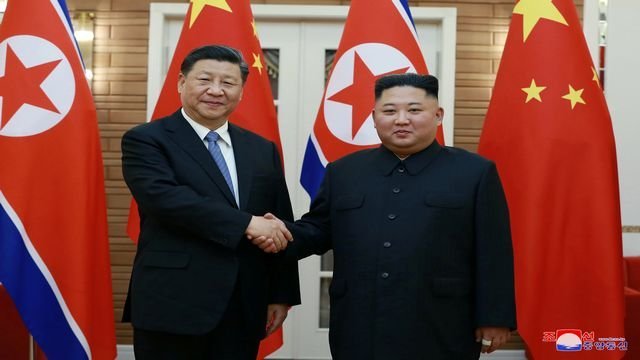
Chinese President Xi Jinping’s state visit to Pyongyang marked his first trip to North Korea in seven years. Welcomed with military honors and lavish ceremonies, Xi met North Korean leader Kim Jong Un to reaffirm their countries’ strategic partnership. While the summit emphasized economic and political cooperation, the absence of any mention of denuclearization has drawn global attention, raising questions about China’s evolving stance on North Korea’s nuclear ambitions.
A Rare and Symbolic Visit
Xi’s arrival in Pyongyang was accompanied by grand displays of unity, including parades, flag-lined streets, and a banquet hosted by Kim. The visit underscored Beijing’s intent to reassert influence over its socialist neighbor, especially as Pyongyang has recently deepened ties with Moscow. Analysts note that Xi’s presence signals China’s determination to remain North Korea’s primary ally in the region.
Strategic Cooperation Beyond Borders
During the summit, Xi pledged to expand cooperation in trade, agriculture, construction, science, and technology, while Kim described ties with China as North Korea’s “unchanging strategic choice.” Both leaders emphasized sovereignty and security, presenting their alliance as a bulwark against U.S. influence in East Asia.
Nuclear Silence and Global Implications
Notably, neither leader publicly addressed North Korea’s nuclear program, despite Pyongyang’s recent announcement of plans to expand its arsenal “at an exponential rate.” Experts interpret China’s silence as a policy shift toward tacit acceptance of North Korea as a nuclear state, prioritizing bilateral relations over denuclearization. This stance could complicate regional security, prompting U.S. allies such as South Korea and Japan to strengthen defense ties with Washington.
Balancing Russia and China
Kim’s outreach to Xi comes after closer alignment with Russia, including joint appearances with President Vladimir Putin. By reaffirming ties with Beijing, Pyongyang appears to be balancing its relationships with both powers, ensuring economic and political support while maintaining its nuclear posture. Analysts suggest China’s renewed engagement aims to counter Russia’s growing influence in North Korea.
Conclusion
Xi Jinping’s visit to Pyongyang has reshaped the dynamics of Northeast Asia. By strengthening ties with North Korea while sidestepping nuclear issues, China has signaled a pragmatic approach that prioritizes strategic influence over denuclearization. For Kim Jong Un, the summit elevated his global stature and reinforced North Korea’s position as a nuclear power. The alliance, while celebrated in Pyongyang, raises pressing questions for regional stability and international diplomacy.